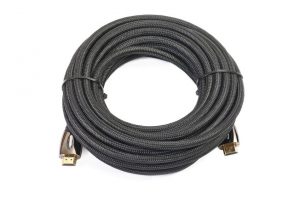
All HDMI cables are designed to deliver crisp and high-quality video and audio. There are many types of HDMI cables and the choice of purchasing one can be difficult for inexperienced people. The first thing to understand is that the purpose of any HDMI cable is to send uncompressed video and audio signal from point A to point B. Every HDMI cable is capable of doing this and the rest will depend on the manufacturing process and the state of the cable itself. All good HDMI cables are certified, standard HDMI is the most common one and can be easily found in most stores and households. If a cable comes with no mark whatsoever, as well as having a low price, it’s probably a good idea to avoid it.
An HDMI’s most common enemy is cable length. Most high-speed and standard cables work very good with distances of 16 feet, any more than that and the signal quality will suffer. For most people, a standard HDMI cable should work just fine. The cables can be found in most stores and are not that expensive. They should receive a good image quality regardless if using standard or high speed. High-speed cables should be considered when owning a 4K device so that it can comfortably deliver the high-resolution video signals. But regular HDMI cables should do just fine is the distance between the devices is less than 16 feet.
Besides being able to deliver high bandwidth, high-quality HDMI cables also have features that cannot be found on standard ones. As mentioned before, the longer the cables are, the poorer the signal will become. Many high-quality HDMI cables come with signal boosters. The signal boosters are placed at either end of the cable to help boost the signal over longer distances and maintain signal integrity. Build quality is also an important factor, especially for the cable’s connectors. High-quality cables have gold plated connectors that help in reducing radio interference with the signal as well as increase the connectors sturdiness. Other cables are made of copper conductors and high-density polyethylene to make the cables last longer.
A lot can be said just by looking at the cable build quality. While you cannot view an HDMI’s cable quality directly, a lot can be said from its connectors. Unfortunately, connectors of a poorly manufactured HDMI cable tend to break after a bit of stress. The quality of an HDMI cable can also affect sound quality. While the improvements are only slight, a good quality HDMI cable may help in reducing distortion and interference which will result in better sound quality.
In our times, because 4K televisions have mostly replaced the 1080p ones, most people use high-speed HDMI cables to be able to transmit that resolution. Recently, there is a new player on the market, the HDMI 2.1 which is a huge step up in terms of bandwidth speeds. The incredible speed can deliver up to 8K resolutions at a very high frame rate, as well as dynamic HDR.
As a summary, high-quality HDMI cables are the ones that offer great bandwidth performance, sturdy connectors and signal amplifiers that help the cable deliver data for longer distances. The build quality will depend entirely on the manufacturer and what to look for would be a decently priced long HDMI cable with the required certifications.